
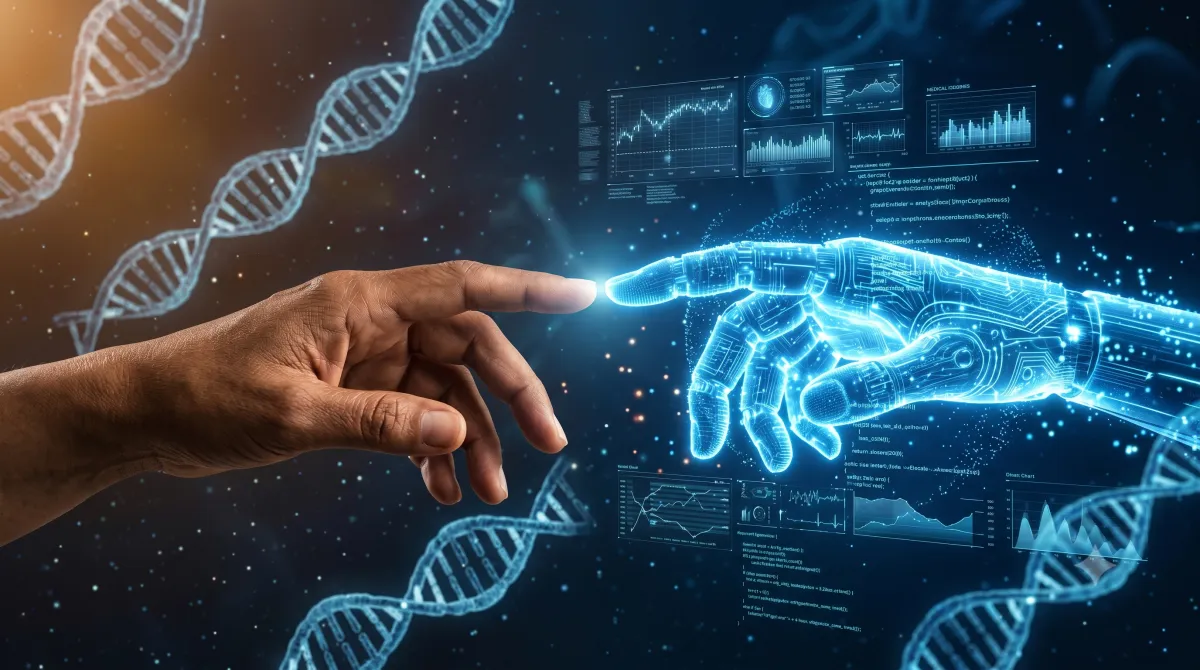
Imagine carrying a virus inside your own DNA that doctors can see but can’t treat. This is the reality that millions wake up to every day.
For more than 40 years, Human immunodeficiency virus (HIV) has defied all attempts to cure it. Today, antiretroviral therapy (ART) keeps millions of people alive and healthy—but does not cure them. When treatment ends, HIV comes back. The real cure has been the hardest problem in medicine.
But something's happening. Artificial intelligence — the same tech behind self-driving cars and language models — is now being used on one of humanity’s most infamous viral foes. Scientists are optimistic but wary.
In this blog, we discuss exactly how AI could help cure HIV, the breakthroughs that are already taking place, and the challenges still to be addressed.
Why HIV Has Been So Hard to Cure
To understand the role of AI, first it helps to understand why it’s so exceptionally hard to conquer HIV.
It’s not just hanging out in the blood when a person is infected with HIV. It integrates itself into the DNA of immune cells – mainly CD4 T cells—and can lie completely dormant for years. This is known as the latent viral reservoir (the hiding place HIV uses within your own cells). ART drugs, standard ones, are excellent at suppressing active HIV replication, but they cannot detect or destroy these silent, hiding cells.
According to global statistics from UNAIDS (2024), approximately 39.9 million people were living with HIV in 2023. There were 1.3 million new infections, and 630,000 people died from AIDS-related illnesses—all in a single year.
The problem is threefold:
- HIV hides in the body's own DNA
- It mutates rapidly, outpacing drug development
- The immune system alone cannot find and kill every infected cell
This is exactly where AI comes in.
1. AI predicts drug resistance before it happens
One of AI's first and most impactful contributions to HIV care is predicting how the virus will respond to treatment.
Machine learning models can analyze thousands of viral genetic sequences and clinical histories to identify patterns that human clinicians might never spot. One pioneering tool—the HIV Treatment Response Prediction System (HIV-TRePS)—allows doctors to upload a patient's data and receive AI-guided recommendations on which drug combinations are most likely to work and which are likely to fail due to resistance.
A meta-analysis of 24 studies involving over 400,000 people living with HIV found that machine learning models showed strong potential for assessing long-term mortality risk and enhancing clinical decision-making. Tools like random survival forests and support vector machines (SVMs) are now helping clinicians make far more precise prognoses.
The result? Fewer failed treatments, less drug resistance, better patient outcomes—well before a cure is found.
2. Mapping the HIV Reservoir Hidden with AI
The biggest barrier to curing HIV is the reservoir of dormant infected cells. Simply put: you cannot destroy what you cannot find.
In April 2026, the Foundation for AIDS Research (amfAR) launched a landmark $2 million initiative to tackle exactly this problem. Their HIV Immune Atlas Study is using AI to build a comprehensive map of how HIV disrupts immune function and evades treatment. The resulting AI models are expected to become a crucial scientific resource, accelerating the path to a cure.
This mapping is the critical first step for the "kick-and-kill" strategy. To destroy the virus, researchers must first "kick" or wake it up from dormancy. AI is now helping scientists design that initial kick with unprecedented precision.
With AI identifying the targets, other emerging technologies are stepping up to deliver the payload. In tandem with the mapping efforts, researchers at the Peter Doherty Institute in Melbourne recently developed LNP X—a novel lipid nanoparticle. This vehicle delivers mRNA directly into those hidden white blood cell reservoirs, instructing the virus to reveal itself so the immune system can attack it. It is a milestone previously considered impossible.
3. AI + CRISPR: The Revolution of Gene Editing
Perhaps the most exciting frontier is the marriage of AI with CRISPR gene-editing technology, often described as “molecular scissors” that can cut DNA at precise locations.
Scientists at the University of Amsterdam successfully removed HIV from infected cells using CRISPR, demonstrating for the first time that it is physically possible to cut HIV DNA out of a human cell.
In early 2025, a team at the Ragon Institute (MIT/Harvard) used CRISPR to edit the CCR5 gene—a doorway HIV uses to enter cells—in over 90% of human blood stem cells, with minimal off-target effects. The goal: permanently close the door HIV uses to infect the body.
A particularly promising clinical trial—EBT-101 by Excision Biotherapeutics—is the first CRISPR gene therapy administered intravenously designed to attack the latent HIV genome. Results from the Phase 1/2 trial presented at the International AIDS Conference 2024 showed a promising safety profile, and the therapy was able to target only the intended DNA. Researchers called it "highly unique" and a significant first step.
AI's role here is critical: it helps design the guide RNAs that direct CRISPR to the right location in the genome, predicts off-target effects before a patient ever enters a trial, and models how edited cells will behave over time.
As molecular biologist Elena Herrera Carrillo from Granada, Spain, noted:
"The long-term goal is for a one-time or limited treatment that either excises or permanently inactivates HIV DNA."
4. Personalised Medicine: AI Tailoring Treatment to You
HIV does not behave the same way in every person. Genetics, immune history, viral subtype, and co-existing conditions all affect how the disease progresses — and how it should be treated.
AI is enabling a new era of personalized HIV medicine. According to a 2025 study published in PMC, advances in machine learning, deep neural networks, and multi-omics data analysis are enabling precise prognostication, tailored antiretroviral therapy, and early detection of drug resistance—all adapted to the individual patient.
AI-driven health apps are also helping patients manage their own care—monitoring adherence, predicting risk of treatment failure, and flagging early warning signs before they become crises.
5. AI Accelerating Vaccine Development
The holy grail of HIV research for 40 years has been a vaccine that can prevent HIV infection altogether. It’s been very difficult, because HIV mutates so fast that a traditional vaccine can’t keep up.
AI is now being used to design broadly neutralizing antibodies (bNAbs) — proteins that can neutralize many different strains of HIV at once. AI can analyze millions of viral sequences, find conserved portions of the HIV protein that don’t change very much, and design antibodies to those portions.
Alongside this, paediatric studies in South Africa showed that some children who started ART early entered remission off therapy—inspiring new trials on therapeutic vaccines and gene therapies designed to replicate that effect.
The Challenges: What AI cannot do, at least for now
It’s important to be honest about the hurdles that remain.
The data problem. The quality of AI models is directly linked to the data they are trained on. If clinical datasets are biased, for instance by over-representing some populations, then the AI’s recommendations may be less effective or even harmful for the underrepresented groups.
The delivery problem. CRISPR (Clustered Regularly Interspaced Short Palindromic Repeats) might be able to edit out HIV from cells successfully in a lab, but safe delivery to all infected cells in a living human body is a huge unsolved challenge.
The equity problem. As health advocates have raised, new treatments like lenacapavir face serious concerns about affordability and fair distribution in low-income countries—where the HIV burden is highest. A cure that only wealthy nations can access is not a cure for humanity.
The timeline problem. A 2025 peer-reviewed study noted that the world is still not on track to end AIDS as a public health threat by 2030—the UN's Sustainable Development Goal—highlighting how much urgency remains.
What’s Ahead?
The consensus among researchers is that no single technology will cure HIV alone. Instead, the future likely involves a combination approach:
- AI to design and personalise therapies
- CRISPR to physically remove the virus from cells
- Broadly neutralising antibodies to eliminate reservoir cells
- Therapeutic vaccines to train the immune system to suppress the virus long-term
A comprehensive review published in February 2025 concluded that although critical challenges remain in bridging the gap between laboratory findings and clinical implementation, the pace of progress has never been faster.
Conclusion: A Race Worth Taking
HIV has outsmarted medicine for 40 years. But AI is changing the rules of the game — compressing decades of research into years, revealing patterns invisible to the human eye, and assisting in the design of precision therapies that would have been unthinkable a decade ago.
We’re not there yet. But for the first time, scientists are talking about not just controlling but also ending HIV.
“There may not be a cure next year.” But with AI in the lab, it feels truly within reach for the first time.